Manners, etiquette & cultural do's and don'ts in Bali
Bali forgives almost everything except rudeness. Learn a handful of habits — how to greet, how to dress, how to barter kindly, and what never to do — and the island opens up to you in a way it doesn't for most visitors.
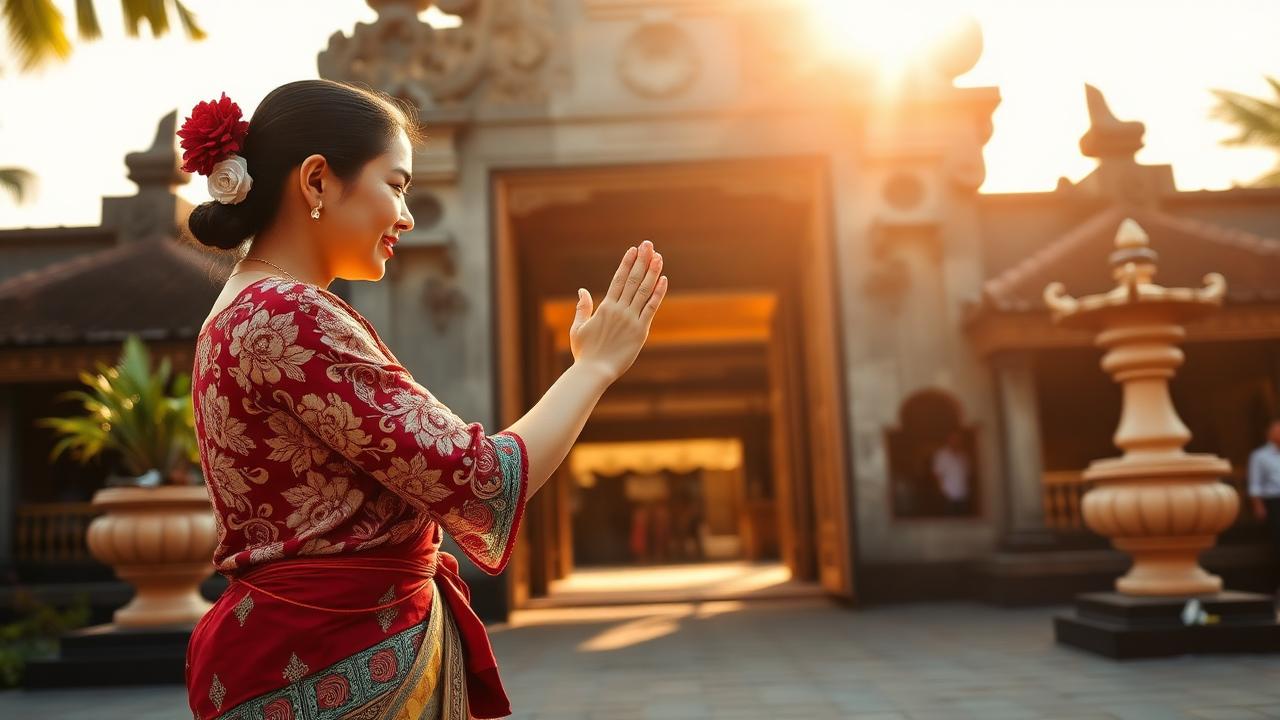
The six things that explain everything else
Get these and most etiquette questions answer themselves.
- Bali runs on calm. Raising your voice, sighing, snapping fingers or showing visible frustration makes you lose face and ends any chance of help — the person will smile, agree, and quietly stop trying.
- Everything is softened first. Start with 'Maaf' (excuse me/sorry) or 'Permisi', then ask. 'Bisa…?' (can you…?) is far better received than a flat instruction.
- A smile is a full sentence here. It can mean yes, no, I don't understand, or I'm embarrassed — don't read it as agreement.
- Balinese rarely say a direct 'no'. 'Maybe', 'later', 'we'll see' or a long pause usually means no. Push once politely, then let it go.
- Religion is daily life, not a backdrop. Offerings (canang sari) sit on footpaths, doorsteps and dashboards — step around them, never over or on them.
- You are a guest on someone's island. The Balinese phrase for the balance they live by is Tri Hita Karana — harmony with god, with people, and with nature. Politeness here is simply not disturbing that.
Body language, gestures and greetings
Most accidental offence here is physical, not verbal — and it's easy to fix.
Hands
Right hand onlyGive, receive, pay, eat and point with the right hand. The left is reserved for bathroom hygiene and is genuinely offensive for handing things over.
Handing over money or a card with two hands, or the right hand touching the left forearm, reads as extra respectful.
Never point with a single finger. Gesture with an open flat hand or the right thumb tucked over a closed fist.
Beckon with your palm facing down and fingers scooping toward you — the western palm-up curl is how you call an animal.
Hands on hips reads as anger or arrogance, particularly if you are complaining.
Head and feet
High and lowThe head is the most sacred part of the body. Do not touch anyone's head, including children's — however affectionate you mean it.
Feet are the lowest. Don't point your soles at people, shrines, offerings or food, don't use a foot to move things, and don't put feet up on furniture in someone's home.
Sit with feet tucked back or crossed when you're on the floor at a ceremony or in a temple.
Remove shoes when entering a home, a family compound, some shops and any building where you see shoes at the door.
Greetings
Easy wins'Om swastiastu' with palms together at your chest is the Balinese greeting and will genuinely delight people. 'Selamat pagi/siang/sore/malam' is the Indonesian equivalent by time of day.
Handshakes are soft, not firm, and often finished by touching your own chest.
Some devout Muslim staff (many Bali workers are from Java and Lombok) won't shake hands across genders — a nod and hand to the heart is always safe.
'Terima kasih' (thank you) or the Balinese 'Suksma' costs nothing and changes how you're treated all day.
Public behaviour
Read the roomPublic displays of affection beyond hand-holding make people uncomfortable, and are a real problem at temples and in villages.
Nudity and topless sunbathing are not acceptable anywhere in Bali, including beaches and villa pools overlooked by neighbours.
Getting visibly drunk in public, riding a scooter shirtless, or shouting in the street draws police attention and community anger — several tourists are deported each year for exactly this.
Never climb on, sit on, or pose disrespectfully with a temple structure, statue or sacred tree. Photos like this have led to deportations.
Drones need permission near temples, ceremonies and many beaches.
What to wear — and where it matters
No, you can't dress any way you like. Beach areas are relaxed; temples, villages and offices are not.
Everyday dress
Relaxed but coveredSwimwear belongs at the beach, the pool and beach clubs — not in supermarkets, warungs, banks or on a scooter. Throw a shirt or sarong on.
Shorts, t-shirts and sundresses are completely fine in Seminyak, Canggu, Kuta and Ubud. Villages, markets, north and east Bali are more conservative — cover shoulders and knees.
For anything official (immigration, banks, hospital admin, meeting a landlord or lawyer), closed shoes and a collared shirt or modest dress gets you taken seriously.
Restaurants and beach clubs may have smart-casual rules at night: no singlets, no wet swimwear, closed shoes for men at the higher-end venues.
Temples
Non-negotiableSarong plus a sash (selendang) tied at the waist is required for everyone, men and women, at every temple. Shoulders covered, knees covered.
Most temples lend or rent a sarong and sash for around IDR 10k–50k or a donation. Buying your own for IDR 50k–150k is cheaper and more respectful over a trip.
Menstruating women are traditionally asked not to enter temple grounds. It's on the signage; it is a religious rule, not a judgement.
Don't enter the inner courtyard (jeroan) unless invited or praying, don't stand higher than a praying person or the priest, and never walk in front of someone who is praying.
No flash photography at prayer, no climbing shrines for a photo, and ask before photographing individuals — especially priests and children.
Anyone with an open wound, and families in the mourning period after a death, are also traditionally asked not to enter.
Ceremonies & processions
If you're invitedIf you're invited to a family ceremony, wear a sarong, sash and a covered top — a kebaya or a collared shirt. Your host will happily help you dress correctly.
Bring a small envelope of money (IDR 50k–200k) if it's a wedding, tooth-filing or cremation; hand it over with your right hand.
Never cut through a procession on foot or by scooter. Pull over, switch off the engine, wait. It may take 20 minutes; that's the price of being here.
Stay lower than the priest, stand at the back, and don't put a camera in anyone's face. A cremation is a family funeral, not a show.
How to barter nicely
Bargaining in Bali is a friendly exchange, not a contest. Done well it's fun for both of you; done badly it's the fastest way to be remembered as a rude tourist.
- Know where it applies. Markets, art shops, sarong stalls, souvenir stands, taxis without a meter and day-charter drivers: yes. Supermarkets, malls, minimarts, restaurants, cafes, warungs, fixed-price shops and Grab/Gojek fares: no — haggling here is rude.
- Open with a greeting and a smile, not a price. 'Selamat pagi. Boleh lihat?' (may I look?) then 'Berapa harganya?' (how much is it?). Tone does more than tactics.
- The usual dance: their first price is often 2–3x in tourist markets. Counter at roughly half, meet somewhere near 60–70% of the asking price, and expect two or three rounds.
- Only ask a price if you might actually buy. Bargaining hard and then walking away with a laugh is the rudest thing tourists do here.
- Never bargain over a few thousand rupiah. IDR 10,000 is under a dollar to you and matters to them — the win isn't worth the bad feeling.
- Useful lines: 'Boleh kurang?' (can it be less?), 'Terlalu mahal' (too expensive), 'Harga terbaik?' (best price?), 'Saya pikir dulu' (let me think about it) as a graceful exit.
- Cash in hand, buying two or three items together, and being the first customer of the day (pelaris — the first sale is considered lucky) all get you a better price than pressure does.
- Once you agree a number, it is agreed. Paying it cheerfully, and saying 'terima kasih', is the whole point.
- For drivers and services, agree the total, the stops, and whether petrol and parking are included before you get in — not at the end.
Conversation: what to say and what to leave alone
Balinese conversation is warm and personal, and avoids conflict at all costs.
- Small talk is friendly, not nosy. 'Where are you going?', 'Are you married?', 'How old are you?', 'How much do you earn?' are normal openers — answer vaguely and laugh if you'd rather not.
- 'Lakar kija?' or 'Mau ke mana?' (where are you going?) is the local 'how are you'. 'Jalan-jalan' — just wandering — is the perfect answer.
- Avoid criticising Indonesia, the government, religion, or comparing Bali unfavourably to Thailand or home. Complaints about heat, traffic and prices land badly.
- Don't discuss caste, and don't ask what someone's caste name means unless they raise it.
- Never joke about drugs, terrorism or bombs, anywhere, ever — least of all at the airport. The consequences are real and severe.
- Complaining well: lead with 'Maaf', blame the object not the person ('this isn't what I ordered' rather than 'you got it wrong'), keep your voice level, and let them fix it. Anger guarantees you get nothing.
- Asking for the manager and threatening reviews is a western reflex that backfires here. Patience and a smile fix problems faster.
Money manners and tipping
- Tipping is not obligatory but is warmly received. Rough guide: IDR 10k–20k for a warung meal or a Grab ride, 5–10% at a restaurant if no service charge is listed, IDR 50k–100k a day for a private driver, IDR 50k+ for a spa treatment, IDR 20k–50k for hotel housekeeping per day.
- Many restaurants add 'plus plus' (++) — service charge and 11% VAT — on top of menu prices. If service is included you don't need to tip again.
- Hand money with your right hand, and don't throw or slide notes across a counter.
- Torn, taped or heavily marked rupiah notes are often refused; check notes when you receive them and ask for clean ones.
- Don't hand cash to children who are begging, and don't buy from children selling on beaches — it keeps them out of school. Give to a registered organisation instead.
- Splitting bills item-by-item confuses staff; one person pays and settles up privately.
If you're invited to someone's home
An invitation into a family compound is a genuine honour. A few small things make you a good guest.
- Take your shoes off at the door and wait to be shown where to sit.
- Bring a small gift — fruit, cakes, coffee or something from your country. Hand it over with your right hand; don't expect it to be opened in front of you.
- Accept the drink you're offered even if you only sip it; refusing outright is a small insult. Wait to be invited to drink or eat with 'silakan'.
- Don't walk into the family temple area of a compound uninvited, and don't photograph it without asking.
- Praise the house, the children and the food. Never point out what's broken or dirty.
- Leave when the conversation naturally winds down, and say thank you to the eldest person present.
The short version
Screenshot this before you fly.
Do
Always- Learn five words of Indonesian and use them badly — effort is what counts.
- Step around offerings on the footpath and driveway.
- Dress modestly away from the tourist strip, and always at temples.
- Ask before photographing people, ceremonies and inside compounds.
- Slow down. Being early, efficient and impatient is not a virtue here — 'jam karet' (rubber time) is real.
- Pull over and wait for processions, and let the ceremony traffic go first.
- Use your right hand for everything social.
- Carry a sarong in your bag — it solves temple entry, cold restaurants and sun in one item.
Don't
Never- Don't touch anyone's head or point your feet or finger at people.
- Don't lose your temper in public — you will lose the argument by having it.
- Don't wear swimwear away from the beach or pool.
- Don't climb on temples, statues or sacred trees for a photo.
- Don't haggle in fixed-price shops or over tiny amounts.
- Don't drink and drive, ride without a helmet, or go shirtless on a scooter.
- Don't discuss or joke about drugs — penalties in Indonesia are extreme.
- Don't feed monkeys, and don't take drone shots over temples or ceremonies without permission.
If you get it wrong
You will, and it's fine.
- Say 'Maaf' immediately, put your palms together, smile, and correct what you did. That is genuinely the whole apology.
- Nobody expects a visitor to know the calendar, the caste language levels or the ritual details. Effort and humility count more than accuracy.
- If you damage or knock over an offering, apologise, don't try to rebuild it, and let the family handle it.
- Serious lines — drugs, disrespecting a temple, nudity at a sacred site, violence — are not cultural missteps, they're legal ones. See the Law & Consequences guide.
- Ask the assistant on this site about a specific situation ('what do I wear to a cremation?', 'is this price fair?') and you'll get a straight answer.