Accessible Bali — wheelchairs, prams, mobility & deaf travel
Bali can absolutely be done with a wheelchair, a walking difficulty or a stroller — but not the way you'd do it at home. Here's the honest state of the footpaths, where to hire equipment, which vehicles actually work, and how to get by if you are deaf, hard of hearing or blind.
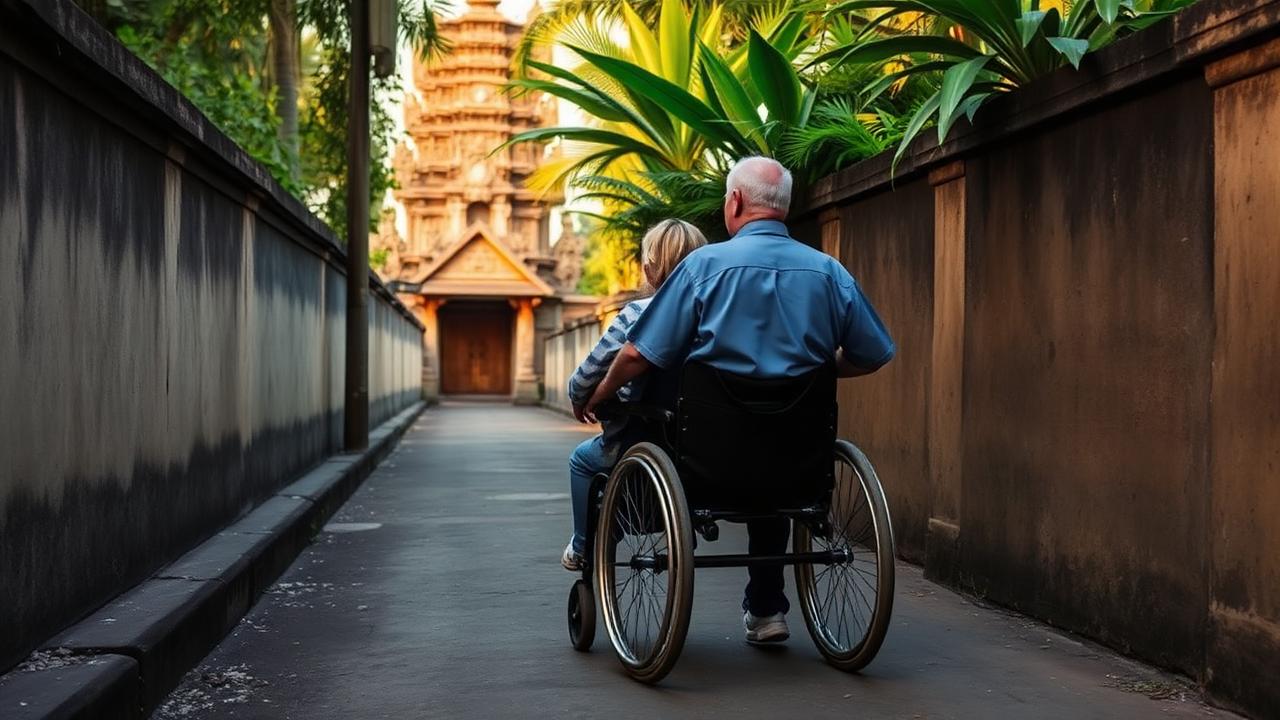
The footpath reality
Read this before you book anything. Bali has almost no accessible pedestrian infrastructure, and knowing that up front changes how you plan the trip rather than ruining it.
- Assume there is no usable footpath. Where one exists it is often a concrete lid over an open drain, with missing or broken slabs, 20–40 cm step-ups at every driveway, and no kerb ramps.
- Poles, parked scooters, warung tables, offerings (canang sari) and tree roots block the paths that do exist, so you end up on the road with traffic.
- Nothing is level. Ubud, Uluwatu, Amed and Sidemen are built on hills with steep ramps and stairs; the flattest walkable areas are Sanur, Nusa Dua and parts of Seminyak.
- Rain changes everything — drains overflow, paths flood and surfaces get slick within minutes in wet season (Nov–Mar).
- Rule of thumb: plan door-to-door by car, not by walking. Treat walking as something you do inside a resort, a mall or on a beachfront promenade, not between destinations.
Where to base yourself
Your choice of area matters more than anything else you decide.
Sanur
Best overallThe 5 km beachfront promenade is flat, paved and continuous — the single best rolling surface on the island for wheelchairs and prams.
Calm, shallow water with a reef break, older resorts with lifts and ramps, and short flat runs to cafes and shops.
Bali Beach/Grand Inna area and the Mertasari end have the widest paths and easiest parking.
Nusa Dua
Resort-flatGated resort estate with wide sealed paths, kerb ramps, gentle gradients and accessible-rated rooms in most 5-star properties.
Bali Collection mall and the beach walk are step-free; several beach clubs will carry a chair over the sand if you ask ahead.
Downside: everything is inside the bubble, and getting out means a car.
Seminyak, Legian & Kuta
MixedMain roads (Sunset Road, Jalan Kayu Aya) have footpath sections but with frequent breaks, high kerbs and heavy traffic.
Beachfront paths at Kuta and Legian are partly paved and workable at quiet times of day.
Gang (alley) accommodation is usually a no — narrow, uneven and often with entry steps.
Ubud
HardestHills, stairs, narrow drain-lid footpaths and rice-field walkways with no railings. The Campuhan Ridge Walk starts with steps.
Doable with a car and a companion, but not self-propelled. Choose accommodation on the flat main road, not down a valley path.
Many temples and cafes have several steps and no ramp; call ahead every time.
Hiring wheelchairs, prams and equipment
You do not have to fly everything in. Prices are indicative — confirm current rates and availability when you book, and arrange delivery to your hotel.
Wheelchairs & mobility scooters
Hire locallyBali-based accessible travel specialists and medical equipment rental shops in Denpasar and Kuta rent manual wheelchairs, transit chairs, rollators, crutches, commodes, hospital beds and sometimes mobility scooters, usually by the day, week or month.
Indicative rates: manual wheelchair around IDR 50k–150k per day or IDR 500k–1.5m per month; electric chairs and scooters are far scarcer and cost several times that. Expect a deposit and a delivery fee to your hotel.
Beach wheelchairs with balloon tyres exist but only through a handful of accessible-tour operators and a few Nusa Dua and Sanur resorts — book weeks ahead.
Big private hospitals (BIMC, Siloam, Kasih Ibu, Sanglah) and the pharmacies around them can point you to a rental supplier and sell consumables the same day.
Repairs: Puspadi Bali in Denpasar is a long-running local disability organisation that makes and services wheelchairs and is the best contact if yours is damaged in transit.
Prams & strollers
Bring the right oneBaby-gear rental services deliver prams, car seats, cots, high chairs and monitors to hotels and villas — roughly IDR 400k–900k a week for a pram, less for longer hires.
Choose three-wheel, air-tyre or all-terrain models. Small-wheeled umbrella strollers are miserable on Bali's surfaces.
A soft carrier or hip seat beats a pram in markets, temples, Ubud and anywhere with steps — most parents here end up using both.
Malls (Beachwalk, Discovery, Level 21, Bali Collection) have lifts, ramps and stroller loans, and are a reliable flat option in the heat or the rain.
Medical equipment & care
Longer staysOxygen concentrators, nebulisers, suction units, pressure-relief mattresses and hoists can be rented in Denpasar; supply is limited, so arrange before you fly.
Home nursing and physiotherapy visits are available in the south for roughly IDR 300k–700k per visit, with live-in carers arranged monthly.
Bring at least a month's worth of your own consumables (catheters, stoma or continence supplies, specific batteries) — local equivalents may not match your sizes.
Carry a doctor's letter for prescription medicines and any medical device you are flying with. See the medication rules on the Before You Go page.
Getting around: vehicles and transfers
Bali runs on cars and scooters. With the right vehicle and a driver who knows what you need, most of the island opens up.
Wheelchair-accessible vehicles (WAV)
Book aheadGenuine ramp or lift vans where you stay seated in your chair are rare in Bali — a small number of accessible-travel operators run converted Hiace or Elf vans. Book weeks in advance, especially July–August and Christmas.
Expect roughly IDR 1m–2.5m for an airport transfer and IDR 1.5m–3m for a full-day charter with driver, depending on the vehicle.
Always confirm ramp width, internal height, and whether the chair is strapped with four-point tie-downs.
Standard cars with a transfer
Most commonThe normal solution here is a Toyota Avanza, Innova or Hiace with a driver who helps you transfer into the seat and folds the chair into the back. Say this clearly when booking so the right driver comes.
A private driver is IDR 600k–900k for 8–10 hours, or IDR 350k–600k for an airport run — far cheaper than a WAV and available everywhere.
Grab and Gojek cars work for a foldable chair and a transfer, but you cannot request an accessible vehicle and the driver may decline. Do not rely on them for a flight.
Rigid frames, power chairs and heavy scooters need a van — a sedan boot will not take them.
Airport, boats & islands
AssistanceRequest wheelchair assistance from your airline at least 48 hours before departure; Ngurah Rai (DPS) has aisle chairs, lifts and staff assistance, and the terminal itself is step-free with lifts.
At arrivals, ask assistance staff to stay with you through immigration and customs — the queue routing is confusing and the walk is long.
Fast boats to Nusa Penida, Lembongan and the Gilis usually load off an open beach or a small jetty with steps, wet ramps and no facilities. Crew will lift you, but it is a manual carry — the chair travels separately. Consider a slower public ferry from Sanur or Padangbai instead.
Nusa Penida's viewpoints (Kelingking, Diamond Beach) are cliff staircases and are not accessible; the island's roads are also rough.
Deaf and hard of hearing
Communication here is already visual and phone-based, which works in your favour more than you'd expect.
Which sign language is used
BISINDOIndonesia's community sign language is BISINDO; SIBI is the older signed-Indonesian system used in some schools. Neither is ASL, Auslan or BSL, so fingerspelling and signs will not match yours.
Bali has a famous deaf-signing village, Bengkala in Buleleng (north Bali), where hearing and deaf residents share a local sign language, Kata Kolok. Visits should go through a respectful local guide, not as a drop-in.
Gerkatin is the national deaf association and has Bali members; deaf community groups and a few deaf-run cafes and workshops in Denpasar and Ubud welcome visitors.
Communicating day to day
What worksTyping beats speaking. Most Balinese staff read basic English on a phone screen, and Google Translate's Indonesian text and camera modes are used constantly here — download the offline Indonesian pack before you arrive.
WhatsApp is the default channel for drivers, villas, restaurants and clinics. Text or voice-note in text form works better than a phone call, and you can send your location as a pin.
Show, don't say: photos of your destination, a screenshot of the address in Indonesian, and written prices avoid every misunderstanding about numbers.
Our phrasebook page has written Indonesian for the sentences that matter most — show the phone rather than attempting pronunciation.
Interpreters: BISINDO interpreters can be arranged in advance through deaf organisations for medical appointments or legal matters; there is no on-demand relay service.
Safety and alerts
Plan for itHotel fire alarms are audible-only in most properties. Ask at check-in for a ground-floor or low-floor room and tell reception you are deaf so staff will come to your door.
Emergency numbers (112, 118/119) are voice lines. Have a hearing travel companion, your hotel's WhatsApp, or a written card ready that states your emergency and blood type.
Carry a printed card in Indonesian: 'Saya tuli. Tolong tulis.' — I am deaf. Please write it down.
Traffic is your biggest risk: scooters approach from behind and rely on horns you cannot hear. Walk facing traffic and check over your shoulder constantly.
Blind and low vision
- Tactile paving exists at the airport and in a few Denpasar streets but is frequently blocked by parked scooters — do not rely on it.
- Guide dogs are legally unusual here and will not be understood by most venues; assistance-animal access is not the norm and food premises may refuse entry.
- A sighted guide or a regular private driver makes the biggest difference. Book the same driver for your stay so routes and doorways become familiar.
- YPK Bali (Yayasan Puspadi/Yayasan Pendidikan Kesejahteraan) and the Annika Linden Centre in Denpasar work with blind and low-vision Balinese and can advise on local services.
- Restaurant menus are rarely available in large print or accessible formats; a phone camera with magnification or Be My Eyes works well over the local mobile data network.
Booking accommodation that actually works
The word 'accessible' means very little in Bali listings. Measurements and photos mean everything.
- Never trust the word 'accessible' on a booking site. Ask for photos with a tape measure or a person in frame.
- Ask these exact questions: how many steps from the street to reception, and reception to the room? Is there a lift, and what are its internal dimensions? What is the bathroom door's clear width? Is the shower step-free or over a bath lip? Is there a raised toilet or grab rails? How wide is the path to the pool?
- Villas are usually worse than hotels: entrance steps, split levels, gravel or stepping-stone paths and rim-lip showers are standard.
- The most reliably accessible properties are large international-brand hotels in Nusa Dua and Sanur with genuine accessible rooms — request one in writing and re-confirm 48 hours before arrival.
- Ground-floor rooms near the lobby beat a better room upstairs. Ask for it in writing at booking, not on arrival.
- Travel insurance: declare your condition and equipment. Wheelchairs and mobility devices need specific cover for damage in transit — airlines break them regularly.
What you can and cannot visit
- Step-free or manageable: Sanur beach promenade, Bali Collection and the major malls, Bali Safari & Marine Park (paved, has chairs to borrow), Bali Bird Park, Tanah Lot's upper viewing areas, Garuda Wisnu Kencana (large paved plazas and lifts), Jimbaran and Sanur beachfront restaurants.
- Partly workable with help: Tirta Empul, Uluwatu Temple's clifftop path, Tegallalang viewpoints from the road, Ubud Palace and Ubud Market frontage.
- Not accessible: most waterfalls (hundreds of steps), Sekumpul, Kelingking Beach, rice-terrace walks, Mount Batur sunrise trek, Lempuyang's gates, and any temple with a traditional split-gate stairway.
- Temple etiquette still applies: sarong and sash for everyone, including seated visitors. Some temples restrict entry during ceremonies regardless of access.
- Beaches: soft sand stops most chairs. Sanur, Nusa Dua and Jimbaran have the firmest access points and some resorts will carry a chair to a lounger if arranged.
Before you commit
A short checklist that saves most of the problems people hit.
- Book a hotel in Sanur or Nusa Dua for the first few nights, then move once you know how you cope.
- Arrange the airport transfer and the equipment hire before you fly — both are scarce and neither can be fixed at 11pm on arrival.
- Hire one private driver for the whole stay rather than app rides, and brief them on transfers, chair folding and how much time you need.
- Pack spare parts, a puncture kit or solid tyres, a charger with a Type C/F plug, and your own cushion.
- Carry a written card in Indonesian explaining your condition and what help you need — showing it is faster than explaining it.
- Ask the assistant on this site about a specific place, hotel or route and it will tell you what's known and what you must verify live.